
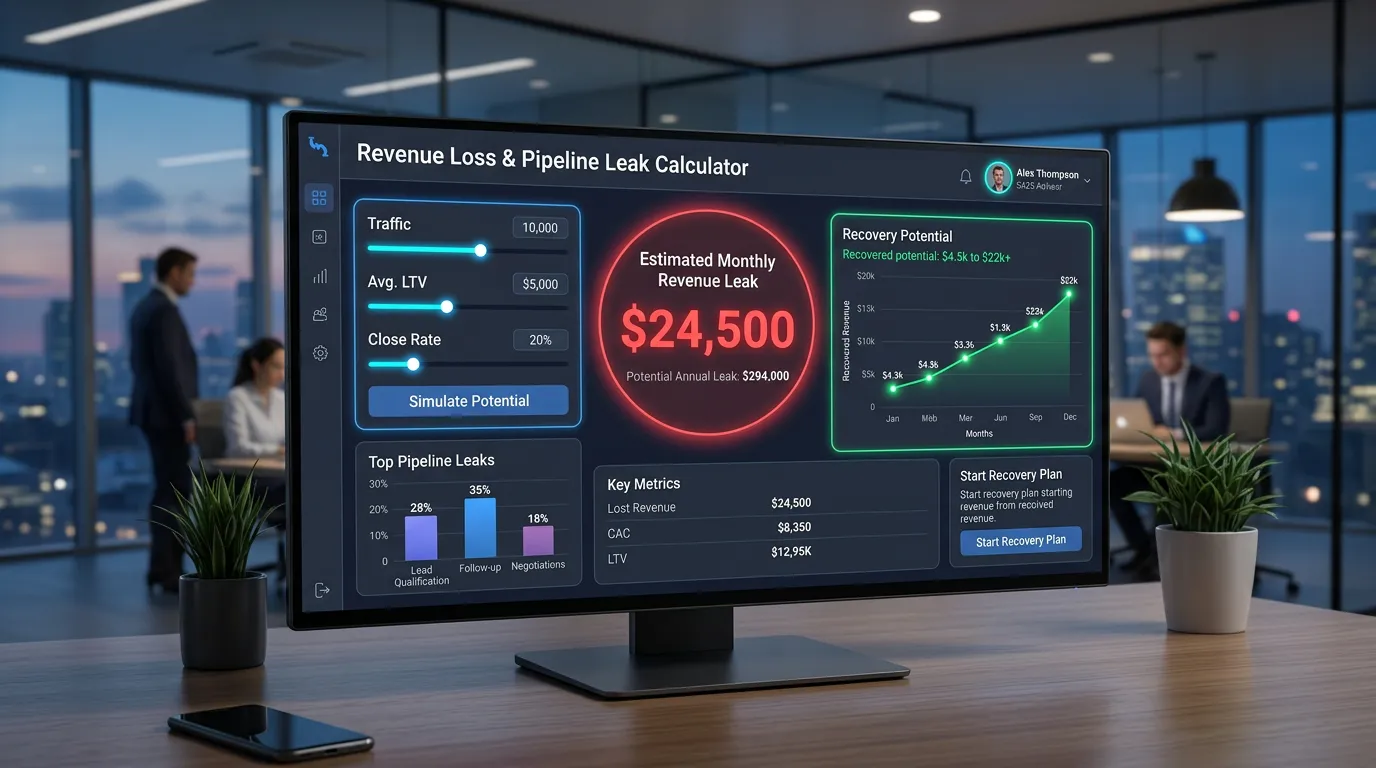
Here’s my question regarding building a AI tool that helps my client who does marketing consulting for their clients, and I hope NeoSymmetry can provide the right solution for this.

Question:
For a marketing consulting company who is a client, I want to build a quiz that is highly effective for generating leads, as follow up once the end user is finished with the very useful quiz. The quizzes that actually convert for a high level marketing consulting are ones that give the prospect something they’d pay for. I’m thinking diagnostic tools… like a pipeline leak calculator where they input traffic, conversion rate, deal size, and it spits out how much revenue they’re losing to slow follow-up. The lead self-qualifies AND sales team gets intel before the call. I’m thinking of building these kinds of tools through NeoSymmetry and the intake quality is very high. Can you design one for me?
Answer:
For a high-level marketing consulting agency, the best lead-gen tool isn’t just a quiz—it’s a Revenue Leak Diagnostic. This tool shifts the conversation from “I need marketing” to “I am losing $X every day,” which is a much more powerful motivator.
Here is the design for a “Pipeline Leak & Recovery Calculator” built for NeoSymmetry integration.
The Diagnostic Concept: “The Revenue Leak Calculator”
This tool targets the “Leaky Bucket” problem: most agencies spend money on ads while losing the resulting leads to slow follow-up or poor nurturing.
Step 1: The User Inputs (The Intake)
To make this diagnostic effective, we need four specific data points. These self-qualify the lead based on their current scale and problem areas.
Step 2: The Logic (The Calculation)
The “Aha!” moment happens when the user sees the Opportunity Cost.
- The Baseline Formula:
- The “Leak” Factor: Industry data shows that responding after 30 minutes drops conversion by 21x compared to responding within 5 minutes.
- The Result: The tool calculates what their revenue could be if they hit a “Best-in-Class” response time (via NeoSymmetry automation).
Step 3: The Output (The Value)
Instead of a “score,” give them a Diagnostic Report on the final screen:
Diagnostic Result: Your Pipeline is Leaking $14,500/Month.
- Follow-up Friction: Your response time of 4+ hours is costing you approximately 65% of your lead engagement.
- Recovery Potential: By automating the first 5 minutes of your intake with a Symmetry Engine, you could recover 4-6 deals per month without spending a dollar more on ads.
- Strategic Insight: Your current traffic is sufficient; your bottleneck is Operational Symmetry.
Step 4: The NeoSymmetry Hand-off (The Sales Intel)
Since you are using NeoSymmetry, the intake data is pushed directly to the sales team’s CRM before the follow-up happens.
Important
Sales Intel Tip: When your consultant calls the lead, they don’t say “How can I help you?” They say, “I saw that you’re losing about $15k a month due to follow-up friction. Let’s talk about how to plug that leak today.”
Implementation Checklist
- Build the logic: Use a simple NeoSymmetry calculator or a tool like Typeform/Outgrow that allows for math variables.
- Webhook to NeoSymmetry: Map the “Revenue Leak” dollar amount to a custom field in the Lead object.
- The “Bridge” Offer: The call-to-action shouldn’t be “Book a Consultation.” It should be “Download your full Leak Recovery Roadmap” (which requires a meeting to walk through).
To give a sensible and high-impact revenue leak estimate, you need to collect data that highlights the gap between current performance and automated potential.
Here are the 7 essential questions for the Revenue Leak Calculator:
1. The Volume (Input)
- Question: “How many new leads or inquiries do you generate per month?”
- Purpose: Establishes the size of the “bucket.”
- UI Tip: Use a slider (e.g., 0 to 1,000+).
2. The Value (Impact)
- Question: “What is the average lifetime value (LTV) of a single new customer?”
- Purpose: Attaches a real dollar sign to every lead lost.
- UI Tip: Input field for currency.
3. The Speed (The “Leak” Factor)
- Question: “On average, how long does it take for your team to respond to a new inquiry?”
- Options: <5 mins | 30 mins | 4 hours | Next Day | 2+ Days.
- Purpose: This is the most critical variable. Industry data shows that responding in 5 minutes vs. 30 minutes increases conversion probability by 21x.
4. The Funnel Health (Conversion)
- Question: “What is your current lead-to-close conversion rate?”
- Purpose: Benchmarks their current state. Most people estimate higher than they actually achieve, which makes the “leak” calculation even more surprising.
5. The Follow-up Persistence
- Question: “How many times do you typically follow up with a lead before stopping?”
- Purpose: 80% of sales require 5+ follow-ups, but 44% of sales reps stop after one. This identifies a major source of “hidden” revenue loss.
6. The Human Bottleneck
- Question: “Do leads arrive during weekends or after hours when your team is away?”
- Purpose: Highlights the “Ghost Hours” leak—leads that go cold because they hit the inbox at 7 PM on a Friday and aren’t touched until Monday morning.
7. The Cost of Acquisition (Optional but Powerful)
- Question: “What is your average Cost Per Lead (CPL) from advertising?”
- Purpose: Allows you to calculate not just lost revenue, but wasted ad spend. Telling a client they are “throwing away 4,000 USD in ad spend” hits harder than “losing 20,000 USD in potential sales.”
The Output “Aha!” Moments
When you present the results, calculate these three figures:
- Monthly Revenue Leak: The total value of deals lost specifically to slow follow-up/ghost hours.
- Annual Recovery Potential: The 12-month impact of plugging the leak with NeoSymmetry.
- The “Speed Gap”: A comparison showing their current response time vs. the 5-minute industry gold standard.
Tip
For the “Marketing Consulting” angle, emphasize Operational Symmetry. If they spend more on traffic without fixing these 7 points, they are simply pouring more water into a leaky bucket.